Services Dropdown
- Communications
- Electrical Construction
- Power Line
- Renewable Energy:
- Solar
- Wind
- Substation
- Technical Services
- Transportation:
- Airports
- Bridges
- Highways


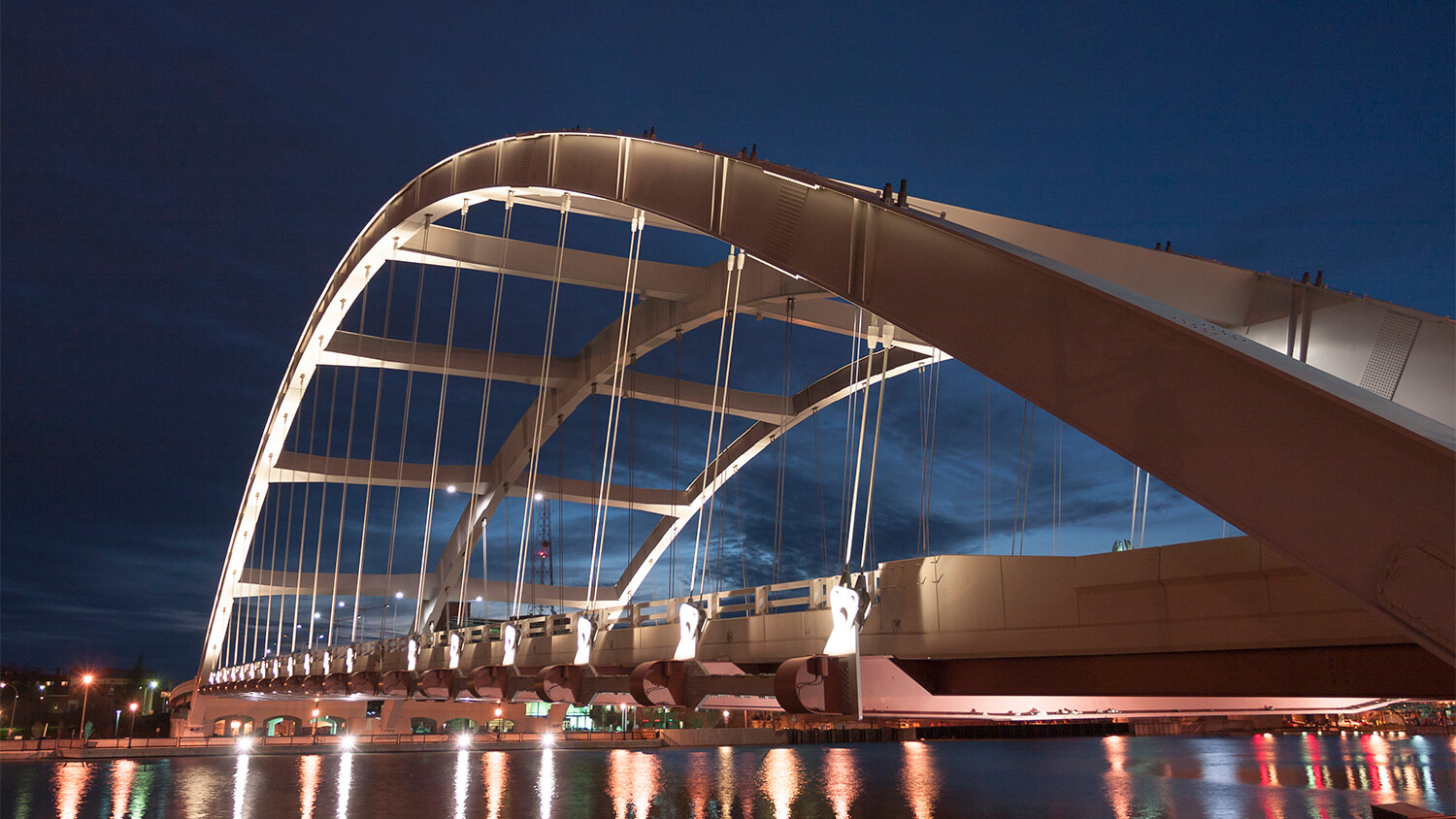
As part of the region’s Western Gateway Initiative the City of Rochester, Monroe County, and New York State embarked on a $38 million bridge replacement project involving the heavily travelled Interstate 490/Rochester Innerloop corridor. The City of Rochester wanted a “signature bridge” to define the area’s redevelopment program for this high profile crossing of the Genesee River. To achieve this, a 433 foot steel cable arch bridge was designed to span the river rising 100 feet above the water. The bridge is one of the widest steel three-rib true arch bridges in the world (130 feet). Decorative lighting arrangements were designed to give the bridge added aesthetic appeal.
In 1972, O’Connell had provided electrical construction services on the former Troup-Howell Bridge for a major lane expansion initiative. Thirty-five years later we were back on location providing electrical construction services for lighting the new bridge. O’Connell aided field engineers in interpreting the electrical plans for the bridge’s innovative accent lighting system and worked closely with the general contractor and New York State DOT to satisfy all electrical objectives. The final results speak for themselves.

Monroe County’s new O’Rorke Bridge was designed to be a landmark structure serving Rochester’s waterfront community on Lake Ontario. The four lane double leaf Scherzer rolling-lift bascule bridge spans 243 feet across the Genesee River, replacing the Stutson Street Bridge which served the area for over 70 years. Highway approach structures from east and west total 678 feet.
Under a $5 million sub-contract from Crane-Hogan Structural Systems, O’Connell Electric provided all electrical construction and data communications work for the new bridge’s power and control systems, highway approach lighting, bridge accent lighting, security systems, and area traffic control signals.
O’Connell’s electrical work for bridge power and control systems was critical for operational reliability. The drive in each of the bridge’s bascule leaves consists of interconnected dual electric motors. Standby power for all bridge systems was supplied by an auto-start diesel generator. The control system allows semi-automatic operation of the drive system via a programmable logic computer.
O’Connell’s fiber optics work included design and installation of two-72 strand submarine cables installed under the river bed, alongside the electric, which linked bridge and highway CCTV systems, several traffic signal controls, a local water and wastewater plant, and controls for future area needs.
The computer controlled accent lighting system O’Connell installed incorporates several service levels spanning “Standard” to “Full Ornamental” for special events.

The Ogdensburg-Prescott International Bridge is a 1-1/2-mile cable suspension bridge spanning the Saint Lawrence Seaway that links the north-central border of New York State with Canada. The bridge is a vital international conduit for the transportation of persons and goods and connects much needed economic development projects for the region on either side of the border. Built in 1960, the Ogdensburg Bridge had recently been categorized as a structurally deficient surface transportation asset. Pursuant to New York State’s adopted Transportation Master Plan for 2030 the bridge was targeted for rehabilitation in order to “achieve a state of good repair” and to ensure the bridge’s longterm viability. The Ogdensburg Bridge & Port Authority partnered with the New York State Department of Transportation to implement the $48 million rehabilitation project. Work included replacement of all main span bridge decking, structural steel floor beams and stringers, raised concrete safety walks, and bridge railing systems across both approach spans and the main suspension spans.
O’Connell is no stranger to large-scale international bridge rehabilitation projects. Our portfolio includes the Thousand Islands Bridge and The Peace Bridge, which is the second busiest boarder crossing between the U.S. and Canada. Under a $3 million contract from the American Bridge Company, O’Connell was tasked with replacement and upgrade of all bridge electrical and communications infrastructure. The new two-conduit raceway system we installed spans the full 7385 foot length of the bridge, one conduit carrying wire and cable for bridge functionality, the other for future international communications. O’Connell installed newly engineered dehumidification systems into sealed vaults, where the bridge stay cables are anchored, as part of the bridge’s comprehensive corrosion protection system. We also installed all new street, bridge, and navigational lighting for the project.
The majority of electrical work and installations needed to be accomplished underneath the bridge’s surface. Demonstrating versatility and adaptability in a challenging construction environment, O’Connell researched, rented, purchased, and modified specialized equipment that enabled our technicians, and other trades, to access work areas from the topside of the bridge. With workmen suspended 100 feet, or more, over water and land during the construction period, job site safety and worker fall protection were an utmost priority. O’Connell demonstrated exceptional safety performance throughout the eighteen-month duration of the project with no reported safety incidents or injuries.
On a project of this magnitude, numerous obstacles and challenges present themselves that could not have been anticipated when bidding the work. O’Connell exhibited both the character and industry leadership qualities we are known for by managing each issue that arose and meeting all project completion schedules.

Rail accounts for 19% of all statewide freight flows in Alabama. The Norfolk Southern Railway is a major U.S. freight railroad company that operates 21,500 route miles of track across 22 eastern states including more than 50% of Alabama’s Class I track.
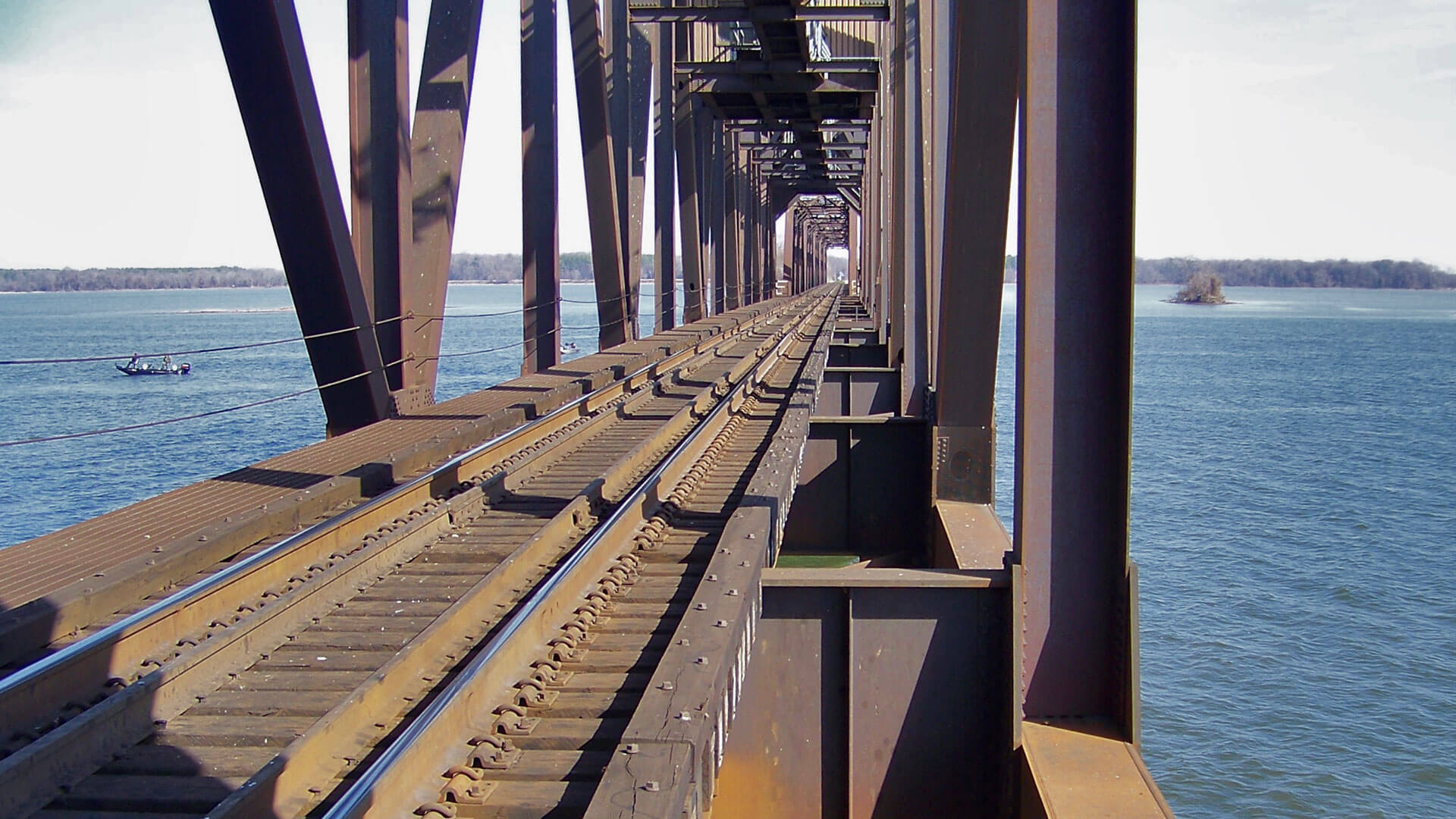
In tandem with priorities and goals outlined in the Alabama Department of Transportation’s “Alabama Rail Plan”, Norfolk Southern’s modernization and expansion initiatives targeted three vertical lift bridges in Alabama and the Norfolk Southern Lake Pontchartrain Rolling Bascule Bridge in Louisiana, the longest rail bridge in the country at 5.8 miles, for upgrade, rehabilitation, and remote control operation. These four bridges are not only critical to Norfolk Southern’s transportation grid, they are integral to the management of Alabama’s nearly 1500 mile system of navigable inland waterways, part of a network connecting 24 states.
O’Connell Electric is one of a select few electrical contractors in the country qualified to bid on this type of work. Norfolk Southern awarded our Transportation Division contracts totaling $5.9 million to rehabilitate the electrical and operating systems of the four bridges—rail and waterway—and upgrade them for remote control operation from a central site. O’Connell coordinated and supervised all machinery replacements for the bridges including new motors, brakes, span locks, and switches as well as installation of new generator platforms and numerous structural repairs.
Innovative project management and construction measures were key to O’Connell’s success and efficiency across the four remote bridge sites. A combination of well-planned prefabrication measures and deployment of custom fabrication trailers fully outfitted with tools and office communications greatly reduced lost job site time. O’Connell ingenuity was responsible for onsite rigging and hoisting systems as well as machinery and equipment replacement practices that eliminated the need for employing barges and cranes or for necessitating marine and rail traffic interruptions. In one instance we were able to place a 4000-pound 125KW generator through a machine room floor hatch more than 100 feet off the ground and rig it over the top of existing equipment within a one-hour rail traffic window.
When centralization of bridge remote operational systems was changed from Norfolk Southern’s Birmingham control center to the Decatur, Alabama, Norfolk Southern Tennessee River Bridge site, O’Connell designed and implemented all necessary modifications and additions for the site including new buildings and building amenities, service and power generation systems, and expanded electrical and communications infrastructures. Working closely with our IT subcontractor, O’Connell developed data logging systems across the four bridge network with remote access capabilities, via Norfolk Southern’s intranet, allowing instant review of all bridge operational data for diagnosing potential faults and to determine override measures in emergency situations.
Norfolk Southern’s Signals and Communications divisions contracted with O’Connell later in the project to design and construct a series of new signal and communications buildings, electrical and data wiring, and camera, intercom, and antennae systems.
All work for the four bridge project was completed on time and without disruption to marine or rail traffic. O’Connell has also worked on Norfolk Southern projects in Ohio and Chicago.